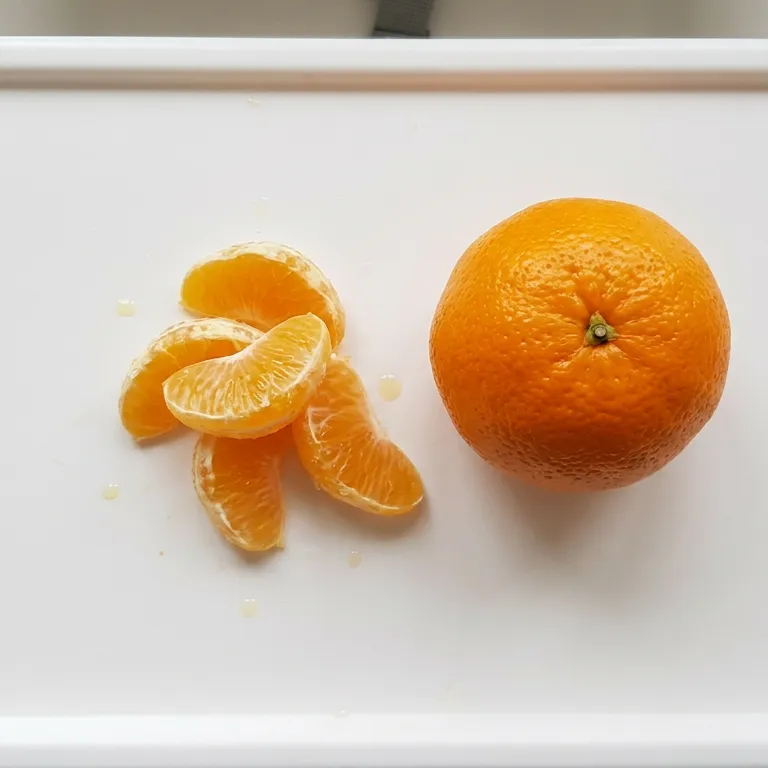
Orange, what it looks like
Orange
Based on IAP, ICMR-NIN and 3 more sources
Safe from 6 months
Vitamin C-richNot a common allergen

From six months, a little orange is a useful thing to add to a meal, and ICMR-NIN recommends it for exactly this: its vitamin C helps her body take up more iron from the rest of her meal. Peeled, deseeded and well mashed, it is soft enough for a six-month mouth as solids begin.

How to serve

6+ monthsStart here
9-12 months
12+ months
Well-mashed segments6+ months

We can start her on mashed orange segments. Peel the orange, strip off the thin white membrane, and pick out every seed, then mash the soft flesh well with a fork. It is juicy enough to need no thinning. You can also spoon a little over her curd, or another soft food she already takes.

Clearing the membrane and every seed is what makes it safe to mash at this age. Keep it plain, with no salt added while she is still under one, and nothing sweetened until she is two, however sour it tastes. Begin with just a spoonful or two, and let her show you when she has had enough.

Small membrane-free pieces9-12 months

Now she can manage small pieces on her own, so this stage calls for pieces she can pick up rather than the mash you started with. Cut the top off the orange, lift each segment free of its membrane pocket, take out the seeds, and break the freed flesh into small bite-size pieces. Lifting each piece is the very practice that strengthens her pincer grasp.

A whole segment still in its membrane stays off her plate. It is slippery, with tapered ends, and can slip back before she is ready.

Spoon, fingers, or both? (coming soon)
Bite-size family pieces12+ months

By a year, orange is just part of what she eats with the family. Serve it as small peeled, deseeded, bite-size pieces. As her chewing gets stronger, she can manage bigger pieces to bite and scrape.

A whole segment still in its membrane is best left until she is chewing really well, closer to eighteen months, since a small intact segment is the easy one to swallow whole. Until then, keep freeing the flesh from the membrane the way you already do.

Spoon, fingers, or both? (coming soon)
Myth busted

A cold or cough comes from a virus, not from a fruit. Orange has no 'cooling' nature, and there is no need to keep it away during winter or a sniffle.

Why?

The idea that citrus is 'cooling' and can bring on a cold runs deep in many homes, yet nothing in a fresh orange cools her body or starts an infection. When the Indian Academy of Pediatrics lists the common wrong beliefs parents hear, this 'cold food' one is on it, and the same guidance counts fruits like orange as essential for children in their diet. If the elders still worry, there is an easy middle path: let the orange sit out of the fridge until it loses its chill, and serve it earlier in the day.

What other moms wonder

Real questions from moms, answered by Anu.

After orange, my baby has a red rash around her mouth and a sore bottom. Citrus allergy?
Scary to see, but it's usually orange's acid, not an allergy, and it settles. That acid can sting skin that is already sore. Get emergency care at once if her lips or face swell, she struggles to breathe, or a rash spreads over her body. For milder loose motion, vomiting, or a rash that stays put, ask your paediatrician.
Starting egg, nuts and other allergens ›
She screws up her face and spits the orange out. Is she rejecting it, or doing something wrong?
That sour-face-and-spit is such a common first reaction to orange, and it is not a no. The tartness surprises her, and spitting is how she works out a new taste. Offer a little again another day. It can take many tries before she warms to it. Nothing you are doing is wrong.
When she refuses food (coming soon)

More questions

Why is orange fine from six months when I keep reading that citrus should wait until a baby is one year old?
Orange is fine from six months, sour taste and all. ICMR-NIN lists orange by name in its diet chart for the six-to-eight-month band, so the wait-until-one-year idea you may have read is not what the Indian guidance follows. If your family would rather wait until she is a little older, that is okay too. Just start the same gentle way, with small mashed amounts. Start here (coming soon)
Should I try baby-led weaning with orange?
With orange, most of us begin with soft mashed segments on a spoon at six months. From about nine months, as her pincer grasp comes in, she can lift the small membrane-free pieces to her mouth. The IAP puts that same step from spoon to finger food at around nine months, so there is no rush. Let her set the pace. Spoon, fingers, or both? (coming soon)
How much orange, and how often?
Orange is fine most days, as one of her daily fruits. Around six to eight months, ICMR-NIN's own diet chart puts a full serving at about half an orange, peeled and mashed. At six months you would start with just a spoonful or two and build up from there. Past that, how much she wants is up to her. It sits especially well right after a meal, when its vitamin C helps her take up more iron. How much she should eat (coming soon)
Is it better to give orange as juice or as the whole fruit?
The whole fruit, easily. Mashed orange gives her the fibre and keeps her from filling up on sweet liquid, so it is the better first form by far. The IAP starts babies on well-mashed foods and steers away from watery things like fruit juice early on. Juice itself can wait: the IAP says none before she is two, and that includes the packaged fruit drinks that reach so many Indian children early.

If this helped, send it to a friend.

Share with a mom friend ›
Talk to meWondering about a food, or something a page doesn’t cover?I check the guidelines and reply. Talk to me on WhatsApp Want to hear when new pages go up?One short note on WhatsApp when a new food or guide is ready. Nothing else. Follow the channel
Educational only, and never a replacement for your paediatrician. Read the full note ›