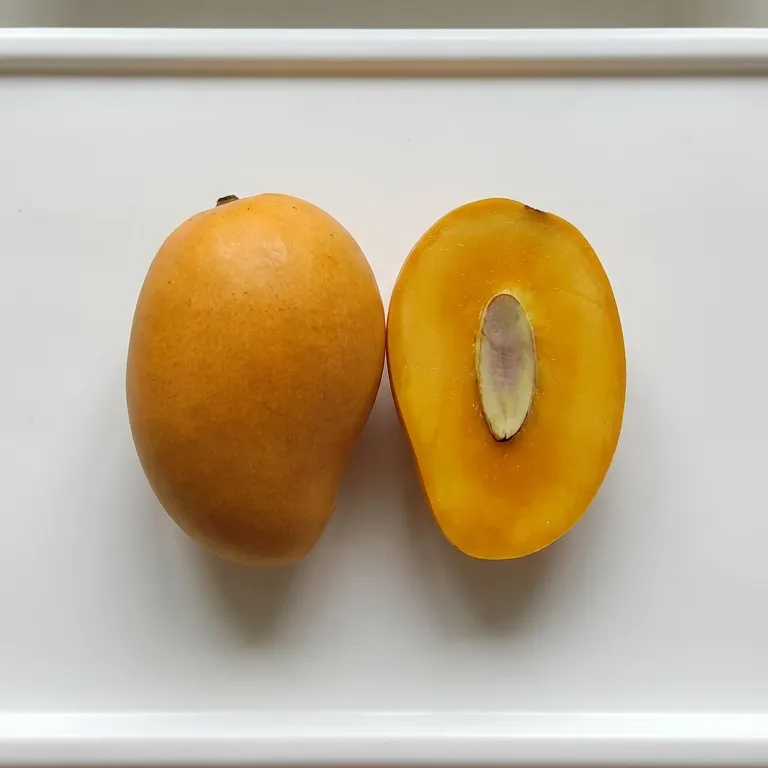
Mango, what it looks like
Mango
Based on IAP, ICMR-NIN and 2 more sources
Safe from 6 months
Vitamin A-richNot a common allergen

Ripe mango is one of the deep-yellow fruits that carry the carotenoids a baby's body turns into vitamin A, and both the ICMR-NIN and the WHO place mango among the fruits that supply this vitamin. It mashes soft and smooth for a new eater. That makes it an easy fit for her fruit portion from the very start of solids at six months.

How to serve

6+ monthsStart here
9-12 months
12+ months
Smooth mashed mango6+ months

We can start her on mashed ripe mango, peeled and with the stone removed, soft and smooth on a spoon. Choose one ripe enough to mash easily with a little pressure, since an unripe mango is firmer and harder for her to take. Properly ripe, it fork-mashes on its own, so you usually need no water or milk to loosen it.

Mango brings plenty of its own sweetness, so no sugar needs adding, and no sprinkle of salt or chaat masala goes on her share in the first year. She may also like a little mashed mango stirred through her curd. Even a couple of small spoonfuls make a fine start, and her appetite will tell you the rest.

Soft spears or small pieces9-12 months

From around nine months, once she is picking things up, you can offer ripe mango in long, soft spears she can hold, rather than round pieces or slippery cubes.

Cut the spears about half an inch wide and long enough for a bit to poke out of her fist, so she has enough to grip. Once her pincer grasp comes in, small bite-size pieces work too.

Spoon, fingers, or both? (coming soon)
Bite-size pieces and wedges12+ months

By her first birthday, ripe mango can join whatever the family is eating, in bite-size pieces and soft wedges.

Keep the pieces properly ripe and soft, and stay close while she eats.

Spoon, fingers, or both? (coming soon)
Myth busted

Mango is safe for your baby right through the summer heat. It does not raise her body heat, or bring on boils or a cough.

Why?

There is nothing in a ripe, soft mango that raises a baby's body heat. The Indian Academy of Pediatrics names mango directly among the foods wrongly called 'hot', and calls the belief false. So there is no need to hold mango back in the summer months. If it eases minds at home, you can serve mango earlier in the day, in a normal fruit portion.

What other moms wonder

Real questions from moms, answered by Anu.

We started mango for my 8-month-old and now there are tiny red bumps around her lips, I'm scared.
Redness where the mango touched her skin is common once solids start, and it usually fades. A real reaction tends to show soon after she eats, so watch her closely for the next few hours. Any swelling of her lips or face, or trouble breathing, needs help straight away.
Starting egg, nuts and other allergens ›
My 10-month-old keeps dropping the slippery mango strips and getting upset. How do I help him hold it?
Setting it on a fork for him to lift often helps while it is this slippery, so he can still bring it to his mouth himself. He will get steadier with practice.
Spoon, fingers, or both? (coming soon)

More questions

My 7-month-old only took vegetables once I mixed in sweet mango. Now I worry she'll only want sweet.
This worry is common, and it rarely comes true. Keep offering the plain vegetable alongside the sweet mango, so she meets that taste again and again. Most babies need a new flavour offered several times before they take to it. When she refuses food (coming soon)
You might hear that mango and milk should never be eaten together. Is it a problem to mix them, or to stir mango into curd or yogurt?
It is fine to stir a little mango into her curd or yogurt, or into another soft food she already takes. The never-mix idea is an old food-pairing belief with nothing behind it. If you would rather, you can always give the mango on its own instead.
Should I try baby-led weaning with mango?
Both spoon and finger feeding work well with mango. Many of us start with smooth mashed mango on a spoon around six months. From about nine months she can hold soft spears herself, and once her pincer grasp comes in, she can pick up small pieces too. Keep it ripe and soft whichever way you go. Spoon, fingers, or both? (coming soon)
How much mango, and how often?
A small serving, about half a small katori, is plenty at the start. Mango can be an everyday fruit, sitting in her fruit portion for the day alongside her dal, cereal, and vegetables. Her own appetite can set how much she takes from there. Mango is sweet on its own, so there is no need to sweeten it, and no sugar should be added for a baby under two. How much she should eat (coming soon)

If this helped, send it to a friend.

Share with a mom friend ›
Talk to meWondering about a food, or something a page doesn’t cover?I check the guidelines and reply. Talk to me on WhatsApp Want to hear when new pages go up?One short note on WhatsApp when a new food or guide is ready. Nothing else. Follow the channel
Educational only, and never a replacement for your paediatrician. Read the full note ›