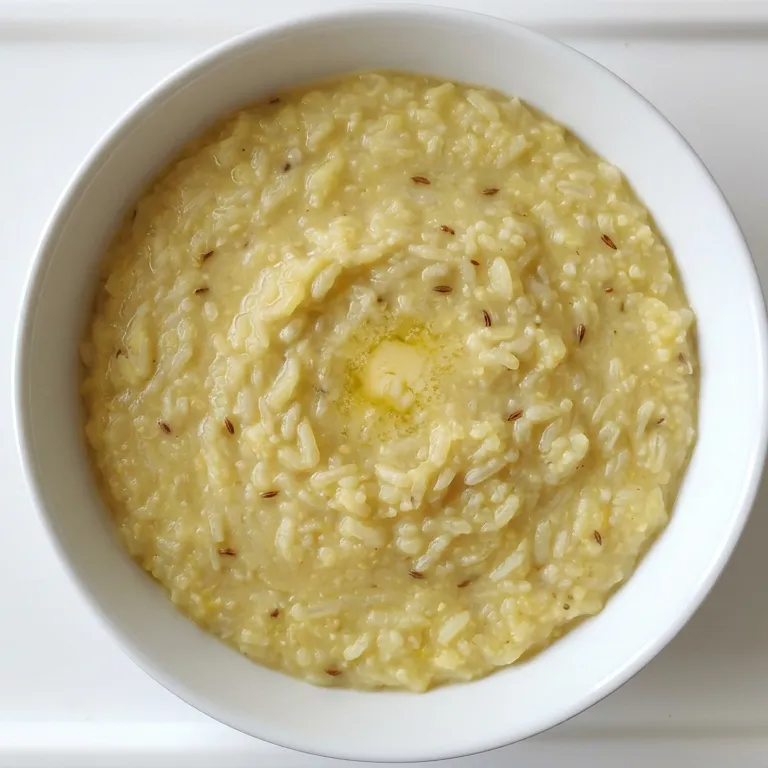
Khichdi puts a cereal and a pulse into one soft bowl. The rice gives her gentle energy, and the moong dal makes the protein more complete than rice on its own. She can start it from six months. The IAP places this cereal and pulse pairing among the first foods that give a baby all her essential proteins.
How to serve
Soft mashed khichdi6+ months
We can start her on soft mashed khichdi from six months. Cook the rice and moong dal together until they are soft and falling apart, then mash them smooth. Loosen it with a little breast milk, formula, or water so it scoops up easily, but keep it on the thicker side so a spoonful holds together rather than dripping off.
A little ghee stirred in adds energy to her small bowl. Keep it plain otherwise, no added salt in her first year, and no sugar or jaggery until she turns two. Begin with a spoonful or two, and let her appetite lead how much she takes.
If your family's khichdi is the heavier toor kind, that is fine too. Many homes simply begin with moong and bring the toor bowl in once she is settled.
Thicker mash with soft lumps9-12 months
By now she can take her khichdi thicker and a little lumpier. Cook the same khichdi she knows until soft, whether that is moong, masoor, or the toor your family uses, then mash it more coarsely so it has small soft lumps she can manage. This is also when soft vegetables can join the bowl, cooked down until they mash easily.
A little ghee still goes in, and her portion stays plain with no added salt.
Soft vegetable khichdi12+ months
From around a year, her khichdi becomes a small vegetable khichdi that she can share at family meals. Cook the rice, moong, masoor or toor dal, and soft vegetables like carrot, peas, and tomato together until everything is soft. You can also cook it a little less smooth and leave it in soft chunks, so she gets used to a coarser texture. Squash any peas so none are left whole and round, keeping her bowl soft all the way through.
Keep her portion light on salt, even when the rest of the family's food is saltier.
A plain khichdi is already a good meal for her. You do not have to add salt or jaggery to get her to eat it.
Why?
She does not need added salt, and no sugar or jaggery until she turns two. This is the age her taste is forming, so plain is exactly what she is learning to like. A small spoon of ghee makes the same bowl richer without any salt or sugar. Give her time. The plain taste she is learning now is one she will keep.
A soft, thick khichdi is safe and gentle for her from six months. It does not need to be thinned into a watery soup for her to manage it.
Why?
A thick, well-mashed khichdi carries far more energy in the same few spoons, while a watery version fills her tummy without really feeding her. She can manage a soft, thick mash at six months. Start it well mashed and smooth, and let it thicken a little as she grows.
What other moms wonder
Real questions from moms, answered by Anu.
More questions