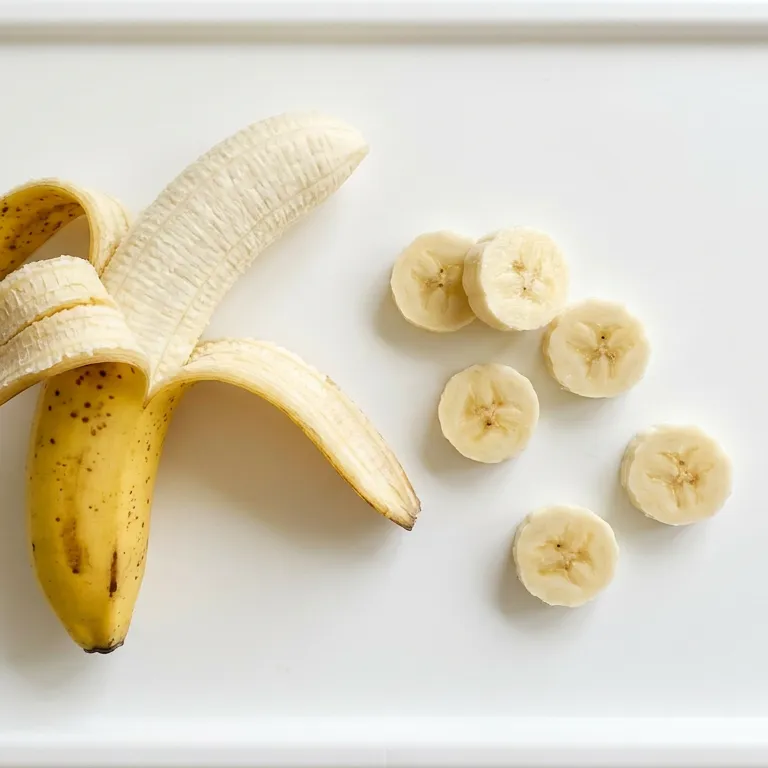
Banana, what it looks like
Banana
Based on IAP, ICMR-NIN and 2 more sources
Safe from 6 months
Not a common allergen

Ripe banana is a soft, naturally sweet food to start at six months. The AAP names banana an easy first food you can serve raw, just mashed, with no cooking. It also gives her a little potassium and quick energy.

How to serve

6+ monthsStart here
9-12 months
12+ months
Smooth ripe mash6+ months

We can start her on ripe banana, mashed to a soft, spoonable paste with a fork. Because it is well-ripened it needs no cooking at all, which keeps the first meal simple. Usually it is soft enough to need no thinning. But if you would like it looser, or closer to a taste she knows, stir in a little breast milk or formula, never cow's milk before she is one.

Once she is settled and eating it on her own, you can mix mashed banana into a porridge or another soft food she is used to. Keep it plain: no added salt in her first year, no added sugar before two, and no honey before one, since honey can cause botulism, a serious illness. Begin with only a teaspoon or two, and from there let her own appetite set the amount.

Soft finger pieces9-12 months

Now she can lift soft finger pieces of banana on her own, cut into short lengths or lengthwise spears about half an inch wide. Lifting each piece to her mouth is exactly how she strengthens the pincer grasp she is building.

Ripe banana is sticky, so she may gag a bit while she works out how to manage it, which is quite normal and not choking. The soft pieces she can squash down are gentler for her than big firm chunks. Give her a small amount and let her eat what she takes to, still with no added salt, sugar, or honey.

Spoon, fingers, or both? (coming soon)
Bite-size family pieces12+ months

By a year, banana just joins whatever the family is eating. Bite-size pieces or soft spears stay the easy everyday forms. Only if she is already handling finger foods well can she take a whole peeled banana and bite her own pieces off it. With your help, she may also start trying to peel it herself from about a year.

It also works mixed into her other foods, mashed through a porridge or stirred through her curd. By now the amount is hers to choose, as one part of her full plate.

Spoon, fingers, or both? (coming soon)
Myths busted

A cold and cough come from a virus, not from a fruit. Banana does not have a 'cold' nature, and you do not have to stop it when she is sniffly.

Why?

A baby's colds and coughs come from viruses, not from the nature or temperature of any fruit. So banana stays safe to give all the way through a cold. The Indian Academy of Pediatrics calls this 'cold food' idea a wrong belief and lists banana as an essential food in a child's diet. If serving it earlier in the day and at room temperature instead of straight from the fridge helps settle worried minds at home, do that. But there is no need to stop it at all.

A well-ripened banana usually helps things move along rather than block them up. It is the firm, under-ripe one that can bind her, not the soft spotty kind.

Why?

As a banana ripens it has more of the soft fibre that helps digestion, while a firmer, under-ripe one has more of the starch that can harden stools. Constipation when starting solids usually has more than one cause, not banana alone. So pick a well-ripened, spotty-yellow banana, and if her stools do harden after starting it, ease back or pause for a week and check with your paediatrician.

What other moms wonder

Real questions from moms, answered by Anu.

My baby loved banana, now she suddenly refuses it. Has anyone else had this happen?
It is unsettling when she turns away from a food she used to love. With banana this is just a passing phase, not anything you did wrong. Offer it in small amounts without pushing, at a calm moment, seated with you and not already full. It can take eight to ten tries before she warms to a food again.
When she refuses food (coming soon)
My 10-month-old gagged so hard on banana pieces it scared me. Should I go back to purées?
Watching that gag is scary, but with sticky banana it happens a lot and is not choking. It is often the way she learns to push food forward in her mouth. There is no need to return to purées, the soft pieces she can gum are fine. A little practice and she will handle them more steadily.
Choking vs gagging ›

More questions

My 7-month-old is small and everyone says banana will fatten her up. Is it that simple?
This pressure is common when a baby is on the smaller side. Banana gives her easy energy, but it helps her most as one of several foods, next to her other foods and milk feeds. What counts is that she stays active and keeps growing along her own steady line, not how much banana she takes.
I've heard banana and milk should never be mixed. Is that bad for my baby?
This is an old belief about mixing foods, and there is no real harm in it for your baby. Banana mashed with a little breast milk or formula is perfectly fine. The one rule that does matter is about cow's milk: as her main drink it waits until she is one, not because of banana, but because it does not have the iron and other nutrients she needs. So the pairing itself is not the worry. Cow's milk (coming soon)
Should I try baby-led weaning with banana?
With banana that step is an easy one. Begin with smooth mashed banana off a spoon at six months, then bring in soft finger pieces from about nine months, once she starts using her pincer grasp to pick things up. The IAP suggests the same nine-month move from mash to finger food. Let her go at a pace that suits her. Spoon, fingers, or both? (coming soon)
How much banana, and how often?
Banana every day is fine, since it counts as her daily fruit. Give a teaspoon or two at the very first taste, then over the next couple of months work up to two to three tablespoons in a meal. Past that point she can have as much as she likes. Still, banana is only one fruit of many, so keep bringing others into the rotation instead of relying on banana alone. How much she should eat (coming soon)
Which kind of banana is best to start with?
All the common ripe varieties are fine from six months, the everyday robusta, the small sweet elaichi or yelakki, nendran, and red banana. The small elaichi and yelakki are easy, soft first picks because they are sweet and mash well. Nendran is firmer and starchier, so many families here steam it first and then mash it. Whichever variety is ripest in your kitchen that week is a good one to start with.
Can banana ever cause a reaction?
Banana is not a common allergen, so it needs no special allergy-watch routine. Very rarely, a baby who reacts to latex or has a condition called FPIES can react to it, with a delayed tummy upset. So the usual calm steps are enough: give a little the first time and watch her over the next few days, and check with your paediatrician if she does react. For nearly every baby, though, it stays a smooth and simple first food, with nothing extra to keep an eye on.

If this helped, send it to a friend.

Share with a mom friend ›
Talk to meWondering about a food, or something a page doesn’t cover?I check the guidelines and reply. Talk to me on WhatsApp Want to hear when new pages go up?One short note on WhatsApp when a new food or guide is ready. Nothing else. Follow the channel
Educational only, and never a replacement for your paediatrician. Read the full note ›